Should You Buy a Ready-Made House or Build Your Own Home in Nepal?
Buying a home is one of the biggest financial decisions most people will make in their lifetime. In Nepal, this decision is becoming even more important as families look for modern, comfortable and safe homes that can serve them for many years.
When the time comes to make that decision, there are generally two choices: buy a ready-made house or purchase land and build your own home.
At first glance, buying a ready-made house may seem like the easier option. The house is already standing, the rooms are finished, the kitchen and bathrooms are in place, and you can see exactly what you are buying. You may even be able to move in relatively quickly.
But there is one important question that is often overlooked:
How much do you really know about what is behind the finished walls?
A newly painted house can look excellent. The floors may be attractive, the kitchen may look modern and the rooms may be beautifully furnished. But many of the most important aspects of a building cannot be judged simply by looking at the finished surface.
How was the foundation constructed? Was the structural design properly followed? Were the right materials used? Was the concrete properly mixed and cured? Was the reinforcement placed according to the structural drawings? Was waterproofing done correctly? Were plumbing and electrical installations properly executed?
These questions matter because a house is not simply a collection of walls, paint, tiles and furniture. It is a long-term structure, and the quality of the work hidden inside it can have a significant effect on its safety, durability and maintenance requirements.
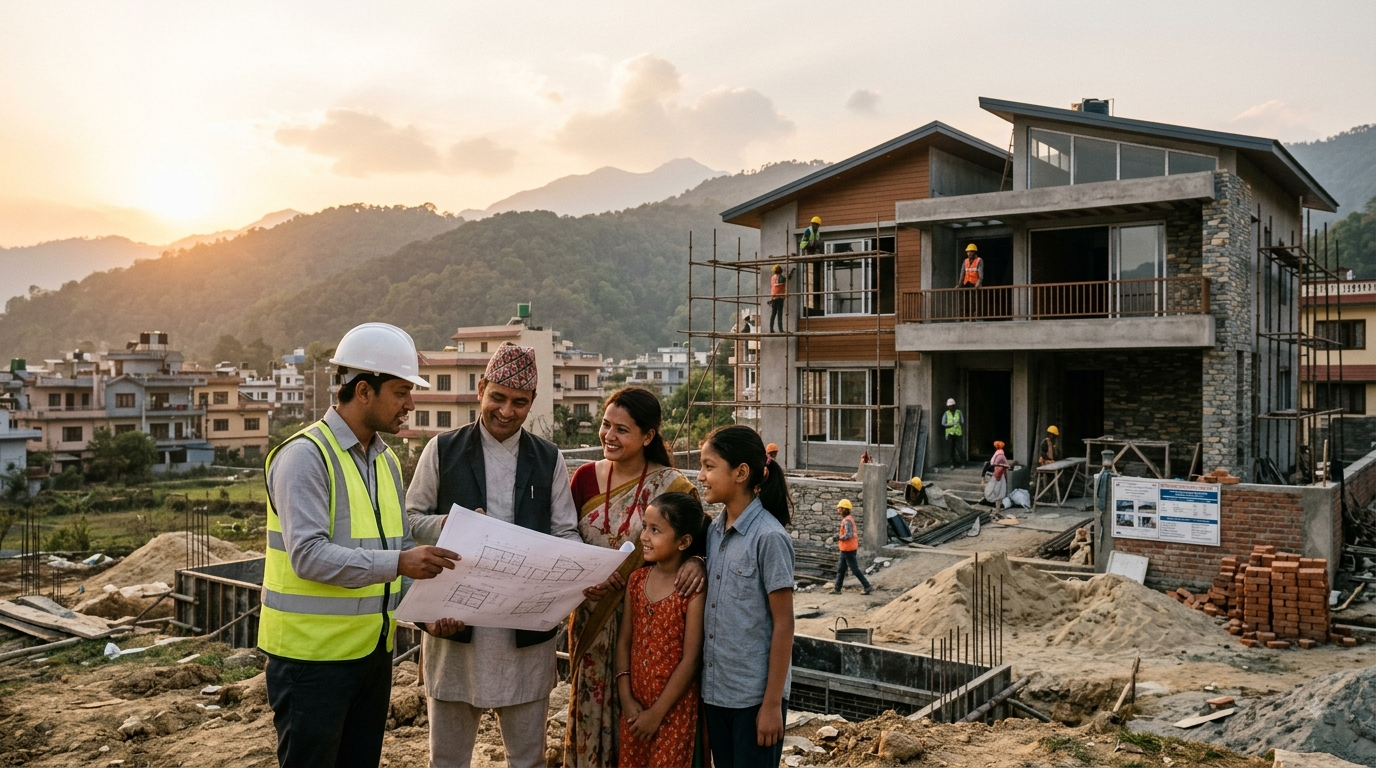
For many families in Nepal, building their own home with the involvement of qualified architects, engineers and a professional construction company can provide greater control and confidence over these important decisions.
Buying a Ready-Made House: The Attraction
There is no doubt that buying a ready-made house has advantages.
The biggest advantage is convenience. You don’t have to start with an empty piece of land and go through the complete process of design, approval, estimation, material selection and construction.
You can visit the property, inspect the rooms, discuss the price and, depending on the situation, complete the purchase and move in much sooner than you could if you were starting construction from scratch.
A ready-made house may also already have important infrastructure such as roads, electricity, water connections, drainage, boundary walls, parking and landscaping.
For someone who needs a home quickly, buying an existing property can therefore be a practical choice.
However, convenience should not mean skipping due diligence.
A buyer should look beyond the appearance of the house and investigate its construction history, approvals, structural condition, maintenance records and any modifications made after the original construction.
This is particularly important because some construction problems are not immediately visible.
What You See Is Not Always What You Get
One of the biggest challenges when buying an already completed house is that the construction process has already happened.
You were not necessarily present when the foundation was excavated.
You may not know what reinforcement was placed inside the columns and beams.
You may not know whether the concrete was properly mixed, placed and cured.
You may not know whether the original structural drawings were followed throughout construction.
And you may not know whether cheaper materials were substituted during construction to reduce costs.
This does not mean that every ready-made house has poor construction quality. There are many well-designed and well-built houses available in Nepal.
The point is simply that a finished house can make it more difficult for the buyer to verify every important stage of construction.
Nepal’s Department of Urban Development and Building Construction (DUDBC) has itself identified building-code compliance, design checking, construction inspection, professional supervision and contractor quality control as important areas for safer construction. DUDBC has also noted that construction can differ from approved design drawings in some cases.
That is why the question should not simply be, “Does this house look good?”
A better question is:
“How well was this house designed, engineered and constructed?”
Problems May Appear After You Move In
Another issue with purchasing a completed property is that some defects may become noticeable only after the house has been occupied for a period of time.
For example, homeowners may eventually encounter:
- Water seepage or dampness
- Cracks in walls or plaster
- Problems with drainage
- Plumbing leaks
- Poor bathroom waterproofing
- Electrical problems
- Uneven or damaged finishes
- Poor ventilation
- Excessive heat inside rooms
- Problems caused by inadequate maintenance
- Structural concerns resulting from inappropriate alterations
Again, these problems are not inevitable in a ready-made house. They can occur in any building if design, materials or workmanship are inadequate.
Research conducted on reinforced-concrete buildings in Nepal has documented structural and construction deficiencies associated with factors including improper construction methods, poor workmanship, inadequate use of building regulations and lack of professional consultation.
The lesson is not that every existing house is unsafe.
The lesson is that construction quality matters more than appearance.
Building Your Own Home: More Work, But More Control
Building your own home requires more planning.
You need land. You need architectural design. You need structural engineering. You need municipal approvals. You need a budget. You need to select materials and contractors. You need to manage the construction process and make decisions throughout the project.
At first, this can sound more complicated than simply buying a finished property.
But there is a major advantage:
You have the opportunity to control the process from the beginning.
When you build your own house, you can establish your requirements before construction starts.
You can decide how many bedrooms your family needs.
You can plan the kitchen around the way your family actually cooks and uses the space.
You can provide sufficient parking.
You can plan natural light and ventilation.
You can create storage areas.
You can consider elderly family members or children.
You can plan a home office.
You can leave provisions for future expansion.
Most importantly, the house can be designed around your land, your family and your future, rather than asking your family to adapt to someone else’s existing design.
Design Is More Than Making a House Look Beautiful
Many people think architectural design is mainly about making a house attractive.
Good design is much more than that.
A professional architect or designer considers the size and shape of the land, access, orientation, natural light, ventilation, circulation, room requirements, parking, building regulations and the way the family will use the home.
The structural engineer then has a critical role in developing the structural system appropriate for the building.
Nepal’s National Building Code includes requirements and guidance relating to seismic design, site considerations, concrete, masonry, reinforcement and other aspects of construction. DUDBC’s current code resources include NBC 105 for seismic design and NBC 205:2024, which includes site investigation, construction materials, structural layout, foundation design and reinforcement guidance for relevant low-rise reinforced-concrete buildings.
This is particularly important in Nepal because earthquake resilience is not something that should be considered only after a building has been completed.
It needs to be considered during planning and structural design.
You Can Choose and Monitor Materials
One of the strongest reasons to build your own home is the ability to make informed decisions about materials.
When you are building, you can establish specifications for concrete, reinforcement steel, masonry, waterproofing, electrical systems, plumbing, windows, doors, tiles, flooring and finishing materials.
You can discuss options with your engineer and construction team based on your budget and requirements.
This does not necessarily mean choosing the most expensive material.
In fact, good construction is not about using the most expensive products. It is about using appropriate materials correctly.
A professional construction process should balance quality, performance, durability and cost.
A cheaper material may save money initially but become expensive if it results in repeated repairs or early replacement.
Similarly, an expensive product does not automatically guarantee good construction if it is installed incorrectly.
The quality of the complete system matters.
Workmanship Matters as Much as Materials
Good materials cannot compensate for poor workmanship.
For example, quality waterproofing material will not perform properly if the surface preparation and application are poor.
Good reinforcement steel will not make a structure safe if reinforcement is incorrectly placed.
Quality plumbing fixtures cannot prevent leakage caused by poor installation.
This is why construction supervision is so important.
A house is built through hundreds of individual decisions and activities. Each stage affects the next.
The foundation affects the structure.
The structure affects the walls and finishes.
Plumbing and electrical work often needs to be coordinated before walls and ceilings are closed.
Waterproofing needs proper preparation and application.
Concrete requires appropriate mixing, placement and curing.
A professional team helps coordinate these activities rather than treating construction as simply buying materials and hiring labor.
DUDBC provides a Construction Handbook for Building Owners specifically addressing appropriate quality control, reinforcing the importance of owners understanding the construction process and quality requirements.
Your Home Should Be Designed for Your Future
A ready-made house was designed for someone else’s requirements at the time it was constructed.
Your family’s needs may be different.
Perhaps you need three bedrooms today but expect your parents to live with you in the future.
Perhaps you need a home office.
Perhaps you want space for children to study.
Perhaps you want additional parking.
Perhaps you want to install solar panels later.
Perhaps you want a rooftop garden.
Perhaps you expect to add another floor in the future, subject to proper structural design and approvals.
When you build your own home, these requirements can be discussed at the design stage.
That is one of the greatest advantages of starting from the beginning.
You are not simply buying a building.
You are planning a home around your life.
What About the Cost?
Cost is probably the biggest question for most families.
Is it cheaper to buy a house or build one?
There is no single answer.
The cost of a property depends on its location, land value, size, construction quality, design, age, finishes, infrastructure and many other factors.
When buying a ready-made house, the price generally includes not only construction but also the value of the land, the seller’s investment, financing costs, development costs and potentially the seller’s expected profit.
When building, you have to account separately for land, architectural and engineering services, approvals, construction, labor, materials, utilities, finishing, landscaping and other project expenses.
This means a simple comparison of the advertised selling price of one house against the construction cost of another can be misleading.
The better approach is to prepare a realistic project budget before making the decision.
A professional estimate can help you understand where your money will go and identify areas where you can adjust the design or specifications without compromising essential quality.
Building Does Not Mean You Have to Manage Everything Yourself
Some people hesitate to build because they imagine themselves visiting a construction site every day, negotiating with workers, purchasing cement and steel, checking measurements and solving technical problems.
You don’t necessarily have to do all of that yourself.
This is where a professional construction company can make a significant difference.
A good construction company can coordinate the process from design and engineering through construction and completion.
Depending on the agreement, services can include:
- Architectural design
- Structural engineering
- 3D visualization
- Quantity estimation
- Cost planning
- Building approval support
- Material planning
- Contractor coordination
- Site supervision
- Quality control
- Construction management
- Finishing and handover
The exact scope should always be clearly agreed with the client before construction begins.
The goal is to give the homeowner a professional team responsible for coordinating the many moving parts of a construction project.
A Professional Construction Company Is Not Just a Contractor
There is an important difference between simply hiring labor and working with a professional construction team.
A contractor may focus mainly on getting the physical work completed.
A professional design and construction company should be looking at the project as a complete system.
The architectural design needs to work with the structural design.
The structural design needs to work with the construction methodology.
The electrical and plumbing systems need to be coordinated with the architecture and structure.
The materials need to match the specifications and budget.
The construction needs to follow the approved drawings and relevant requirements.
And the homeowner needs clear communication throughout the process.
This coordination can reduce mistakes, misunderstandings and expensive changes later.
So, Should You Buy or Build?
The answer depends on your circumstances.
If you need a house immediately, have found a property with a good location and construction history, and have independently verified its condition and documentation, buying an existing house may be the right decision.
But if you already own land—or are planning to purchase land—and you have the time to plan your project, building your own home can provide significant advantages.
You can control the design.
You can establish material specifications.
You can plan the structure properly.
You can design around your family’s lifestyle.
You can monitor construction.
You can work with qualified professionals.
And you can create a home intended to serve your family for decades rather than simply purchasing a building that was designed for someone else’s needs.
Before You Decide, Ask Yourself These Questions
Before purchasing a ready-made house, ask:
- Who designed and engineered the building?
- Are the approved drawings and documents available?
- Was the building constructed according to the approved design?
- Can the structural condition be independently inspected?
- What materials were used?
- How old is the building?
- Has it undergone modifications or additional construction?
- Are there any records of previous repairs?
- Are there signs of seepage, cracking or drainage problems?
- What will future maintenance cost?
If you are planning to build, ask:
- Who will design my house?
- Who will prepare the structural design?
- Has the site been properly assessed?
- What construction standards and specifications will be followed?
- Who will supervise the work?
- How will material quality be controlled?
- What is included in the construction contract?
- How will changes and additional costs be handled?
- What is the expected project timeline?
- What documentation will I receive at completion?
These questions can save you from making an expensive decision based purely on appearance or an attractive initial price.
Your Home Is a Long-Term Investment
A home is different from many other purchases.
You may replace a phone after a few years. You may change a car after several years. But a properly designed and constructed house can remain part of your family’s life for decades.
That is why the cheapest option at the beginning is not necessarily the most economical option over the long term.
A lower initial cost can become expensive if a property requires frequent repairs, major modifications or premature replacement of building components.
Likewise, spending more on professional design and proper construction does not guarantee that every future problem will be eliminated.
What it can provide is something extremely valuable:
better planning, greater control and a stronger foundation for long-term performance.
Build a Home, Not Just a Building
Ultimately, the decision between buying a ready-made house and building your own home comes down to what you value most.
If convenience and immediate occupancy are your priorities, a carefully inspected ready-made house may be suitable.
But if you want to decide how your home is designed, how it functions, what materials are specified and how the construction is managed, building your own home offers a level of control that buying a completed property often cannot.
And you do not have to navigate that process alone.
At Sunrise Designers Engineering & Construction, we believe that a successful home begins long before the first brick is laid. It begins with understanding the client’s needs, studying the site, preparing the right design, developing an appropriate structural system and planning the construction properly.
From architectural design and engineering to construction and project coordination, the objective should be the same: to create a home that is practical, durable, safe and suited to the people who will live in it.
Because when you build your own home with the right professional team, you are not simply choosing walls, rooms and finishes.
You are making decisions about where your family will live for years to come.
So before you ask, “Should I buy a house or build one?”, perhaps the better question is:
“What kind of home do I want my family to live in—and how do I make sure it is built properly?”
For many homeowners in Nepal, starting from the land and building with a qualified professional team may be the best way to answer that question.